
Choosing the right transformer core material is one of the most important decisions in magnetic component design. It directly affects efficiency, size, temperature rise, cost, and the operating frequency range of your transformer, inductor, or choke. This guide compares the most common magnetic core materials — ferrite, iron powder, sendust, MPP, amorphous and nanocrystalline — and gives you a practical framework for selection.
Why Transformer Core Material Matters
The core concentrates and guides the magnetic flux generated by the windings. Its permeability determines how much inductance you get per turn, while its core loss determines how much heat is generated at the operating frequency. Selecting the wrong material leads to oversizing, overheating, or premature saturation — all of which reduce product reliability.
Key Parameters to Compare
When evaluating core materials, compare the following parameters:
- Initial permeability (µi): how easily the material magnetizes — higher permeability means more inductance per turn.
- Saturation flux density (Bs): the maximum flux the material can handle before it stops storing energy effectively.
- Core loss: energy dissipated as heat per unit volume, strongly dependent on frequency.
- Frequency range: the useful operating band of the material.
- Curie temperature: the temperature above which the material loses its magnetic properties.
- DC bias performance: how well inductance is maintained under DC current (relevant for power inductors).
- Cost and availability: critical for volume production.
Magnetic Core Material Comparison
Ferrite Cores (Mn-Zn and Ni-Zn)
Ferrite cores are ceramic materials with high permeability and very low core loss at high frequencies. Mn-Zn ferrite suits frequencies from 10 kHz to about 1 MHz and is the most common choice for switching power supplies. Ni-Zn ferrite extends into the MHz range and is often used in EMI suppression and high-frequency inductors. Ferrite cores are affordable, easy to wind, and available in many shapes such as EE, EFD, ER, PQ, toroid and planar forms.
Iron Powder Cores
Iron powder cores are distributed-gap materials made of iron particles bonded with an insulating binder. They offer high saturation flux density (typically above 1.0 T) and excellent DC bias stability, which makes them ideal for power inductors and filters carrying high DC currents. Their core loss is higher than ferrite, so they are usually limited to lower-frequency applications.
Sendust Cores
Sendust (Kool Mµ) is an alloy of iron, silicon and aluminium. It provides a good balance of permeability, low core loss and low magnetostriction, with higher saturation than ferrite. Sendust is a popular choice for PFC inductors, filter chokes and differential-mode inductors where a combination of stability, low loss and moderate cost is required.
MPP Cores
MPP (Molybdenum Permalloy Powder) cores have the lowest core loss among powder cores and very stable inductance over a wide temperature range and DC bias. They are the premium option for precision filters, resonant circuits and applications where minimum loss and stable inductance are critical.
Amorphous Cores
Amorphous metal cores (metallic glass) offer high saturation flux density and extremely low core loss at medium frequencies. They are widely used in distribution transformers, EV charging, welding machines and power conversion where high efficiency matters.
Nanocrystalline Cores
Nanocrystalline cores are the modern high-performance material. They combine very high permeability (up to 80,000–100,000), very low core loss, and high saturation flux density. Common applications include precision current transformers, common-mode chokes, EV charging transformers, and high-precision measurement devices.
How to Choose the Right Core Material
- Define the operating frequency — this narrows the choice immediately: below 1 MHz consider ferrite or powder cores; above that, Ni-Zn ferrite or high-frequency ferrite grades.
- Check the DC bias requirement — if a large DC current flows, powder cores (iron powder, sendust, MPP) hold inductance better than ferrite.
- Calculate core loss budget — for high-efficiency or continuous-duty designs, choose low-loss materials such as nanocrystalline, MPP or low-loss ferrite.
- Consider size and cost — ferrite is usually the cheapest; nanocrystalline and MPP are premium options.
- Verify thermal performance — make sure the core operates below its Curie temperature with margin.
Shaanxi SiRui Technology Co., Ltd Core Product Range
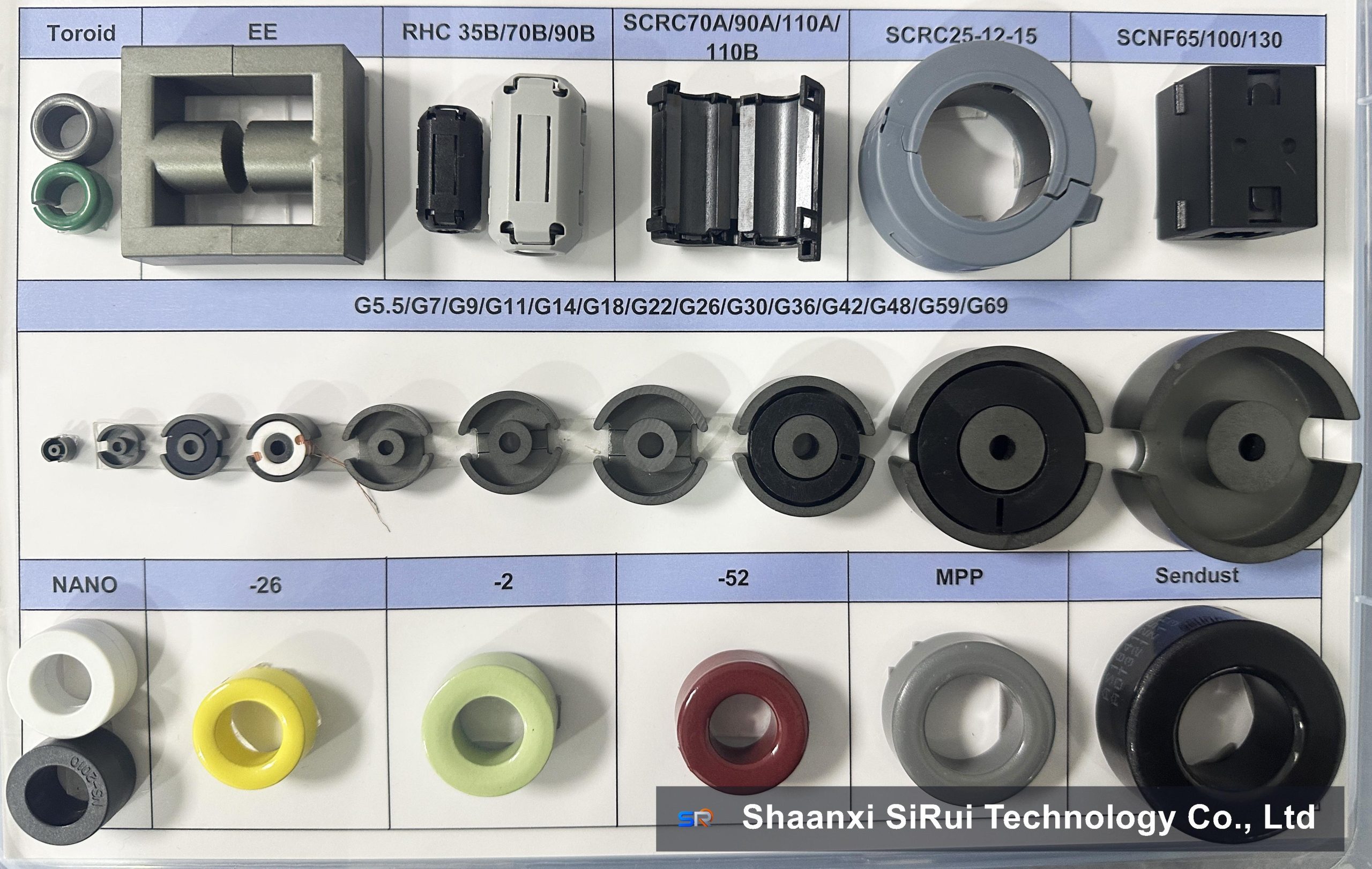
Shaanxi SiRui Technology Co., Ltd manufactures a wide range of magnetic cores including ferrite cores, iron powder cores, sendust cores, MPP cores, amorphous and nanocrystalline cores, covering toroid, EE, EFD, ER, PQ, SCRC, SCNF and many other shapes. All products are manufactured under ISO 9001:2015 quality management and comply with RoHS and REACH requirements.
FAQ
What is the best transformer core material for high frequency?
For high-frequency applications above 100 kHz, Mn-Zn ferrite (up to ~1 MHz) or Ni-Zn ferrite (above 1 MHz) is usually the best choice due to low core loss. Nanocrystalline cores are excellent for high-frequency, high-efficiency transformers.
What is the difference between iron powder and ferrite cores?
Iron powder cores have higher saturation flux density and better DC bias stability but higher core loss. Ferrite cores have much higher permeability and lower high-frequency loss but saturate at lower flux density and perform poorly under DC bias.
Why choose nanocrystalline cores?
Nanocrystalline cores offer very high permeability, very low core loss and high saturation flux density, making them ideal for precision current transformers, common-mode chokes and high-efficiency power conversion.
Related Articles
- Common mode choke: working principle & selection guide
- Mini PCB current transformers: key specs & selection guide
Talk to Our Engineers
Not sure which core material fits your application? Contact Shaanxi SiRui Technology Co., Ltd and our engineers will help you select the right magnetic core with samples and datasheets — free of charge.