
Common mode chokes (CMCs) are one of the most effective components for suppressing electromagnetic interference (EMI) in power electronics. They filter common mode noise on input and output lines while allowing the desired differential signal to pass. This article explains how common mode chokes work, what parameters matter, and how to choose the right one for your design.
What Is a Common Mode Choke?
A common mode choke is a magnetic component that presents a high impedance to common mode currents — noise currents that flow in the same direction on both conductors of a cable — while presenting a low impedance to normal (differential) currents. It typically consists of two windings wound on a single magnetic core, usually a toroid or a shell-type core made of ferrite or nanocrystalline material.
How Does a Common Mode Choke Work?
In normal operation, the load current flows in opposite directions through the two windings, so the magnetic fluxes generated cancel each other. The choke therefore behaves like a low-impedance conductor. When common mode noise flows in the same direction through both windings, the fluxes add, creating a high impedance that attenuates the noise. This self-cancelling behaviour makes the CMC an elegant EMI solution with virtually no impact on the signal path.
Key Parameters of a Common Mode Choke
- Impedance at frequency: the common mode impedance at the noise frequency of interest (typically specified at 10 MHz or 100 MHz).
- Rated current (IDC): the DC current the choke can carry without excessive temperature rise.
- DC resistance (DCR): contributes to copper loss and temperature rise.
- Inductance: common mode inductance, usually specified in mH at a given frequency.
- Dielectric withstanding voltage: the isolation between windings, important for safety in mains applications.
- Leakage inductance: determines the differential mode filtering effect.
Common Mode Choke vs Differential Mode Inductor
A common mode choke suppresses common mode noise; a differential mode inductor suppresses differential mode noise. Many EMI filters use both: the CMC handles conducted emissions on the line, while differential mode inductors and X/Y capacitors handle the differential path. Understanding the difference is essential when designing input filters for switching power supplies.
How to Choose the Right Common Mode Choke
- Determine the noise spectrum — measure or estimate the frequency range of the common mode noise you need to suppress (typically 150 kHz – 30 MHz for conducted emissions).
- Select core material — ferrite CMCs are cost-effective for most applications; nanocrystalline CMCs offer higher impedance per volume and better saturation behaviour, ideal for compact high-power designs.
- Check rated current and DCR — the choke must carry the full line current with acceptable temperature rise.
- Verify impedance at the target frequency — choose a part whose impedance peak covers your noise band.
- Consider size and mounting — through-hole, SMD and vertical/horizontal toroid formats are available.
Applications of Common Mode Chokes
- Switching power supplies and adapters
- EV chargers and on-board chargers
- Solar inverters and energy storage systems
- Industrial drives and motor controllers
- Data centers and server power supplies
- Medical equipment and instrumentation
Shaanxi SiRui Technology Co., Ltd Common Mode Choke Range
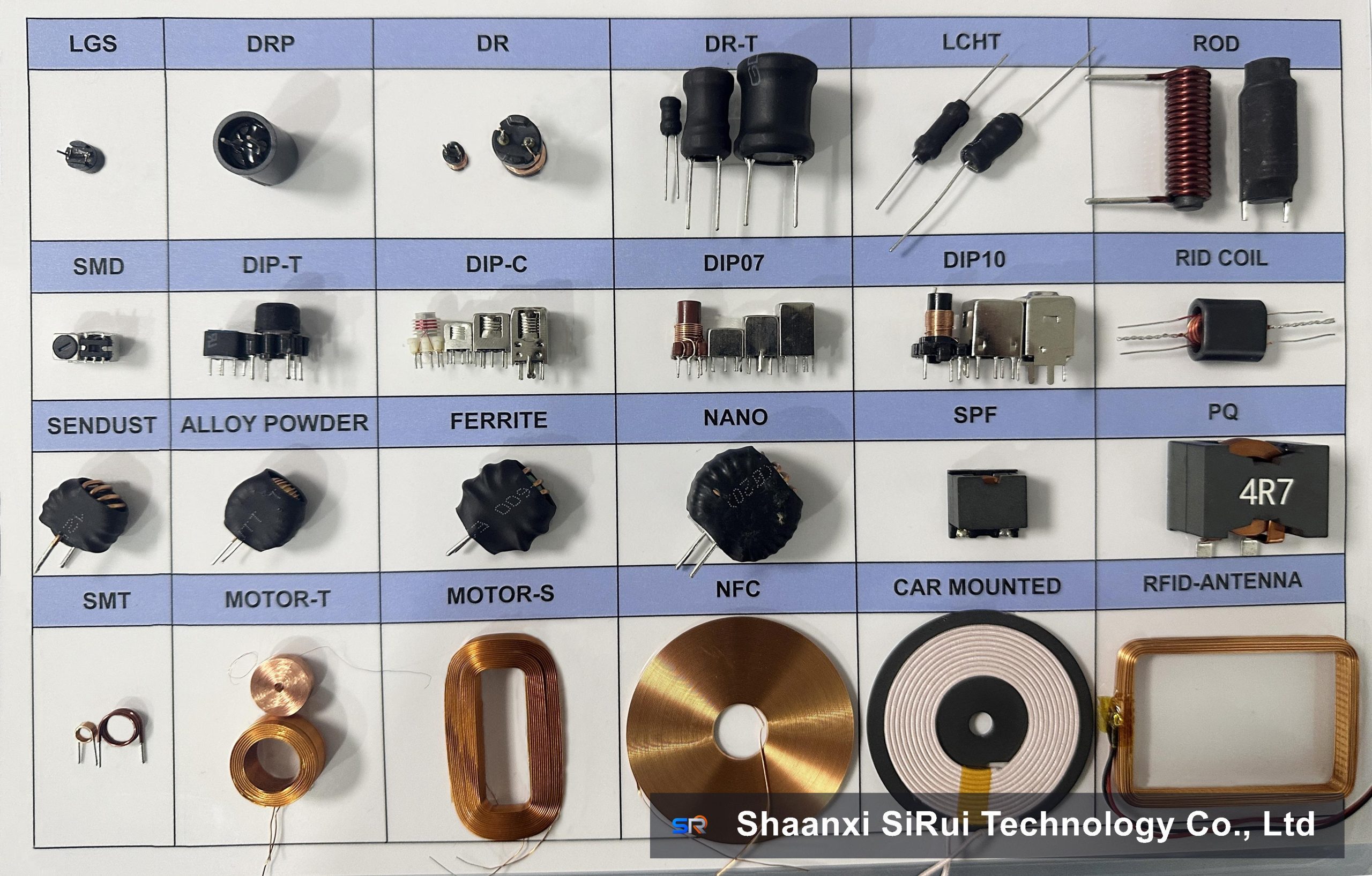
Shaanxi SiRui Technology Co., Ltd supplies a complete range of common mode chokes and EMI filter components built on ferrite and nanocrystalline cores, covering through-hole, SMD and compact toroid packages. Products are designed for demanding EMI requirements and are manufactured under ISO 9001:2015 with RoHS and REACH compliance.
FAQ
Does a common mode choke block normal current?
No. Because the two windings carry equal and opposite load currents, their fluxes cancel and the choke presents negligible impedance to normal current. It only blocks common mode noise.
What core material is best for a common mode choke?
Ferrite is the most common and cost-effective choice. Nanocrystalline cores provide higher impedance per unit volume and better DC bias stability, making them ideal for compact, high-current applications such as EV chargers.
Why is my common mode choke getting hot?
Heating is usually caused by excessive DC current (copper loss), high common mode current, or a core material with excessive loss at the operating frequency. Verify the rated current and impedance requirements.
Related Articles
- Transformer core materials: ferrite vs iron powder vs sendust vs MPP vs nanocrystalline
- Mini PCB current transformers: working principle & selection guide
Talk to Our Engineers
Need help selecting a common mode choke for your EMI filter? Contact Shaanxi SiRui Technology Co., Ltd — our engineers will recommend the right part, provide samples and share detailed datasheets.