
Mini PCB current transformers are compact, low-cost components used to measure alternating current in electronic circuits without breaking the circuit. They are widely used in energy meters, power monitoring, protection circuits and smart devices. This guide explains how PCB current transformers work, their key specifications, and how to select the right one.
What Is a Mini PCB Current Transformer?
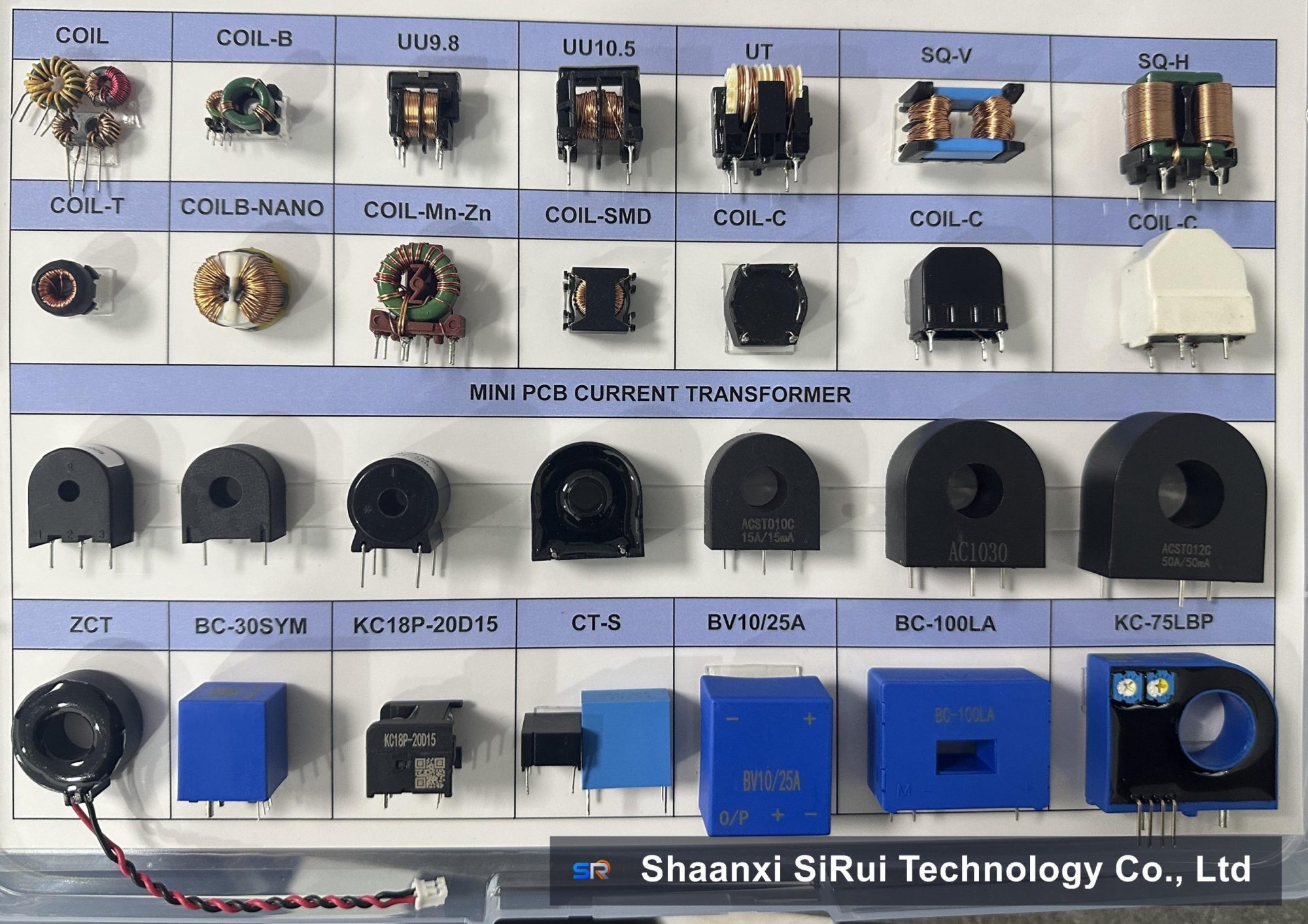
A PCB (printed circuit board) current transformer is a miniature current transformer designed for direct mounting on a PCB. It steps down a primary current to a small, measurable secondary current, providing electrical isolation between the power circuit and the measurement circuit. Typical products include ZCT (zero current transformer), BC, KC, CT-S and BV series.
How Does a PCB Current Transformer Work?
The primary conductor passes through the transformer window (or forms a single turn), and the secondary winding — usually hundreds or thousands of turns — is wound on a high-permeability core such as nanocrystalline or permalloy. The secondary current is proportional to the primary current divided by the turns ratio. A burden resistor converts the secondary current into a voltage that an ADC or metering IC can measure.
Key Specifications to Consider
- Rated primary current: the nominal current the transformer is designed to measure, e.g. 15 A, 50 A, 100 A.
- Rated secondary current: typically 15 mA, 50 mA or 100 mA at rated primary current.
- Turns ratio and accuracy class: e.g. 0.5, 1.0 class for metering applications.
- Burden resistor value: determines the output voltage per ampere.
- Phase error: important for power measurement.
- Isolation voltage: the dielectric strength between primary and secondary.
- Frequency range: most PCB CTs are designed for 50/60 Hz; wideband versions support higher frequencies.
Applications of Mini PCB Current Transformers
- Smart meters and energy metering
- Power quality monitoring
- Overload and leakage protection
- EV charging and renewable energy monitoring
- Industrial automation and motor protection
- IoT and smart home devices
Current Transformer vs Hall Effect Sensor
Current transformers are passive, self-powered, and inherently accurate, but they only measure AC. Hall effect sensors can measure AC and DC but require a power supply and are more expensive. For AC metering and protection at low cost, a PCB current transformer is usually the best choice.
How to Choose a Mini PCB Current Transformer
- Define the current range — select the rated primary current and acceptable overload capability.
- Choose the output type — current output (mA) with external burden, or voltage output modules.
- Check accuracy — for metering, select a transformer with suitable accuracy class and phase error.
- Verify the operating frequency — 50/60 Hz for mains, or wideband for higher-frequency measurements.
- Confirm isolation and safety ratings — ensure sufficient dielectric strength for your application.
Shaanxi SiRui Technology Co., Ltd PCB Current Transformer Range
Shaanxi SiRui Technology Co., Ltd manufactures mini PCB current transformers including ZCT, BC, KC, CT-S and BV series, based on high-permeability nanocrystalline and permalloy cores for high accuracy and low phase error. All products comply with ISO 9001:2015 quality management and RoHS/REACH regulations.
FAQ
Can a PCB current transformer measure DC?
No. Standard current transformers rely on AC-induced flux change and cannot measure DC. For DC measurement, use a Hall effect sensor or shunt resistor.
Why use a current transformer instead of a shunt?
Current transformers provide galvanic isolation, consume almost no power, and are safe at high voltages. Shunts are cheaper but dissipate heat and lack isolation.
What is a ZCT current transformer?
A ZCT (zero current transformer) is a ring-type current transformer used for leakage current detection and residual current monitoring. The phase and neutral conductors pass through the window together; any imbalance indicates leakage.
Related Articles
Talk to Our Engineers
Choosing the right PCB current transformer? Contact Shaanxi SiRui Technology Co., Ltd for datasheets, samples and a free engineering consultation.